This November, the works of Imre and Marne van Opstal will take the stage, including the North American premiere of I'm afraid to forget your smile, and a brand new creation, Miriam. Hear from this world-renowned choreographic duo on their inspirations, artistic processes, and what it's like to create in tandem.
What are your sources of inspiration right now? Things in the world, or themes that are moving you, either in general, or as part of your creative process?
Marne: We’ve noticed that we are more and more attracted to try and create the opposite of what the world is doing. I think we live in a very turbulent world that is very heavily discussed in every corner where you look, and I think we also want to bring back a sense of relief, hope, maybe transformation, softness, tenderness. It’s something that we feel like we’re gravitating more towards in our work. At least for the last few pieces that we’ve made.
Imre: I’m also more and more now feeling that I just want to be doing, and less explaining. That comes right away back to conceptualizing your own work, or how you generate movement. To let it first come from the body and less from the mind. And then hopefully, in that way, find meaning without trying to reach for it too hard.
You are working on projects all over the world. How does place, or where your feet are, make a difference in what you’re making?
M: I think the place makes a huge difference. We are both very sensitive to energies – of course, the energies that we bring to the room, but then also, the energies that the dancers bring back to us. That sort of circularity is super important. Of course, the main creation happens in the actual studio, but we also feel that the culture of a company also exists beyond what happens in the studio. That’s what we feel here in Ballet BC; It’s a very healthy, very creative and beautiful culture, and energy to work with. It’s been super inspirational to work with these dancers and see what they can offer us in return.
I: I think a place is held by people. It’s created by people. A place is only alive if the people actually connect to it, and have the same values, the same interests, and the same love and passion they want to put into it. And so, at a place like Ballet BC, with dancers that are coming from different cultures and different places, in that way, place doesn’t really matter. But a place does matter if the people hold it together in the right way.
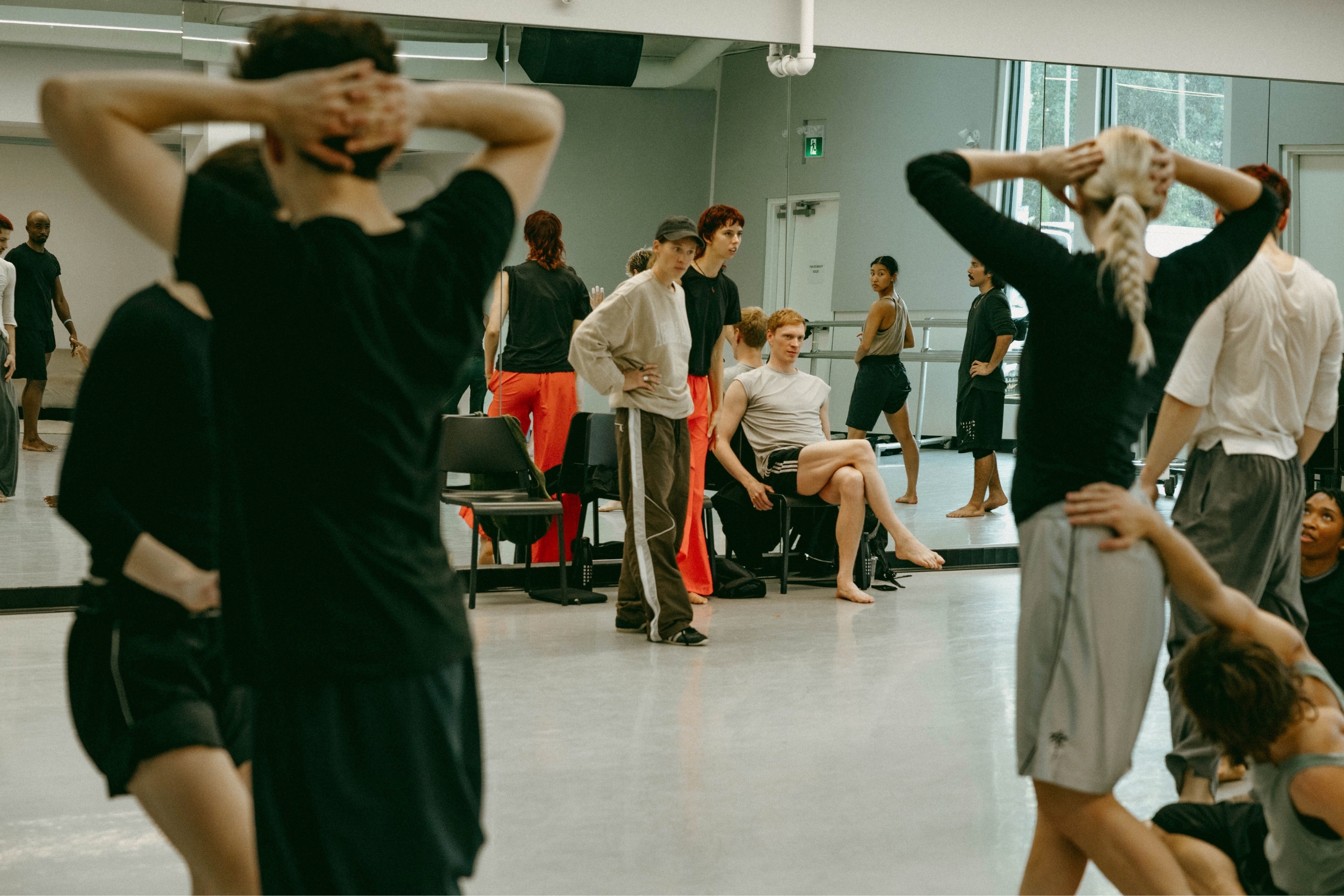 Artists of Ballet BC with Choreographers Imre and Marne van Opstal, and Eve-Marie Dalcourt. Photo by Millissa Martin.
Audiences often seek to understand a work of dance, to put language to movement or make sense of what they are experiencing. How do you think about that?
M: When you’re in creation, you don’t always fully understand the work, and maybe the goal was never to actually fully understand it. Neither should it be for the audience. It is a search. Sometimes we are in the studio, and one time, something can mean one thing, and then the next day, it can mean something completely different. And that is the beauty, that it’s changing, because you are also changing as a person as you observe it.
The way we assign meaning to something is incredibly individual, and that’s the beauty of art. So sometimes we just prefer to speak less, and let the body speak. First through the movement, then let the themes or the conceptual ideas behind the movement reveal itself through the structure of the work.
I: Also, how do you explain feeling? There are so many feelings that we still don’t understand, even though we try so hard. If people come to a theatre and they perceive or can take away a feeling from the show, and it will be very different from everyone, then I think that’s sort of the goal. You don’t need to understand it, but if you can take something away from it, and it can travel beyond the four walls of a theatre, and perhaps you think about it the next day or the week after – I think that’s the beauty of creating something. That something has shifted in someone, and that they can dig for the answers. We’re trying to put feelings to words, feelings to themes, and feelings to many things in life.
How does creating as a duo impact your work?
M: I think what’s interesting about us creating together is that in the first place, we’re brother and sister, so we have that familial bond. We have shared a big portion of our career as dancers, so that has also shaped how we approach choreography. And now we can continue to do so as a shared choreographic voice.
But we are still very much two distinct voices and have our own ideas, and our own angles of looking at things. We choose to do this together because we feel like it enriches our process, and we can learn from each other, and bring different things out. And also, creation can be very lonely. It’s very beautiful to have this sort of echo chamber with you at all times, and to be able to put words to your thoughts, because you’re forced to in a way. If you want to go and make something, you have to sometimes, but not always, decide on the direction that you’re taking. So that pushes you to really think about what you’re feeling, or about what you’re trying to convey.
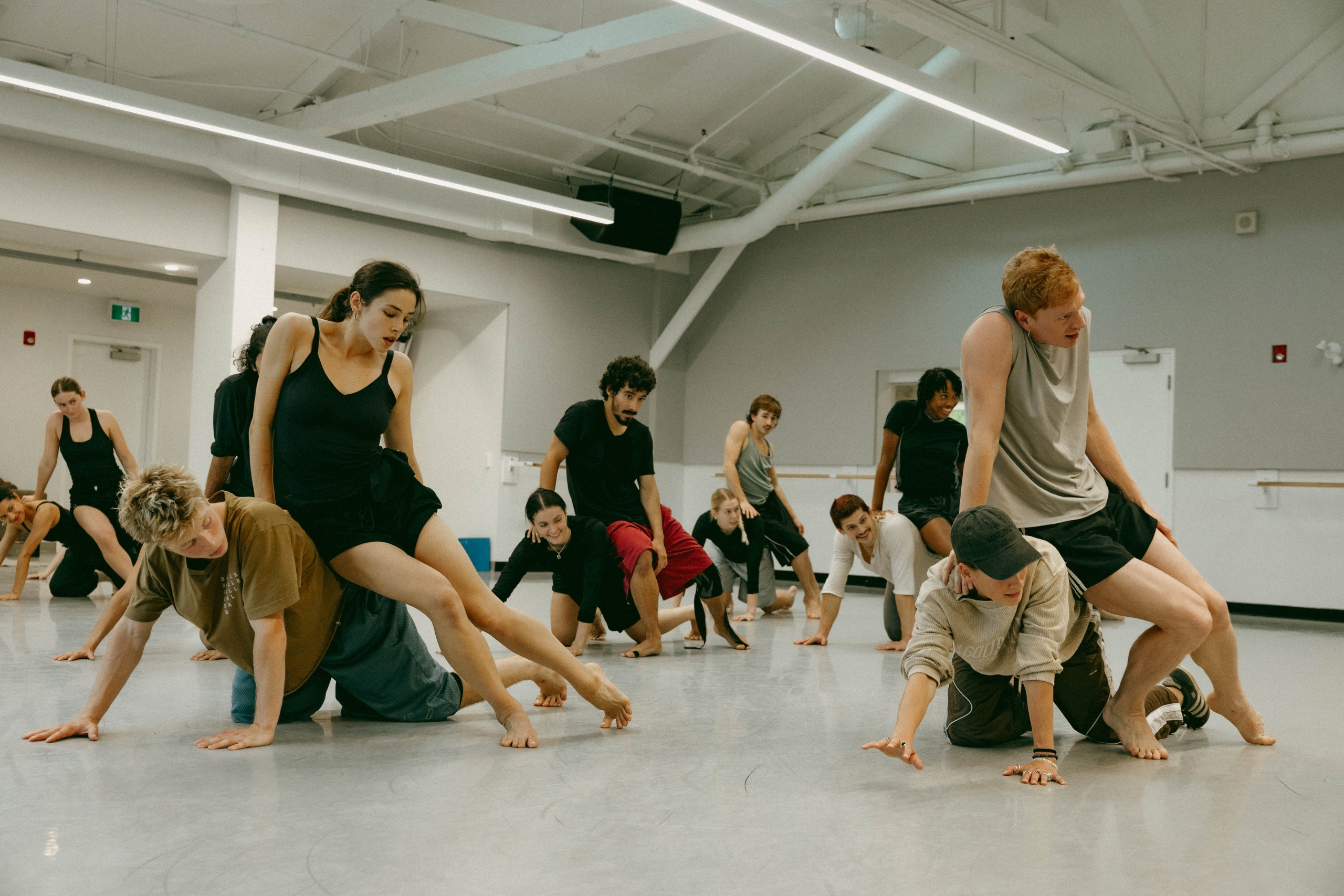 Artists of Ballet BC with Choreographers Imre and Marne van Opstal. Photo by Millissa Martin.
Have you had any specific moments of discovery in the studio that have surprised you?
M: It’s interesting. Every day is full of discoveries, but what is actually beautiful about this creation process is that it’s felt really streamlined. The dancers were completely on board from day one, and we feel like we can actually create what we’ve been feeling and we wanted to express. It is often up to the other people in the room to decide if that is going to be successful. We’ve had a really great time so far, staying very much on course, which is not always the case. It’s been a really beautiful process.
I: As a creator, you can be in that flow state, when you feel like you’re riding that wave and you don’t feel any big bumps on the road. That’s, I think, the best place to create from and to be in. It comes with less stress, and it feels whole, and full, and enriching. You also trust yourself, and your creative partner, and the dancers in front of you to be all on that same ride, which is beautiful.
What is the meaning behind the title of the work? Why Miriam?
I: We’re all doing life together. One of the things that we all have in common is that we all started inside someone else’s body, and before we knew language or before we knew identity or even the sense of “I,” there was always the “we;” that first connection that we ever had was the connection and the relationship with the mother.
This work is not necessarily about the figure of the mother, but more about the portal of creation of life through mother, and that bigger energy that we all carry with us and understand very deeply. Something that is bigger than us. I also think that we as humans, maybe unconsciously, are all perhaps looking for that feeling again to be held by something bigger. So, Miriam is the goddess. It’s the creation. It’s source. It’s life.
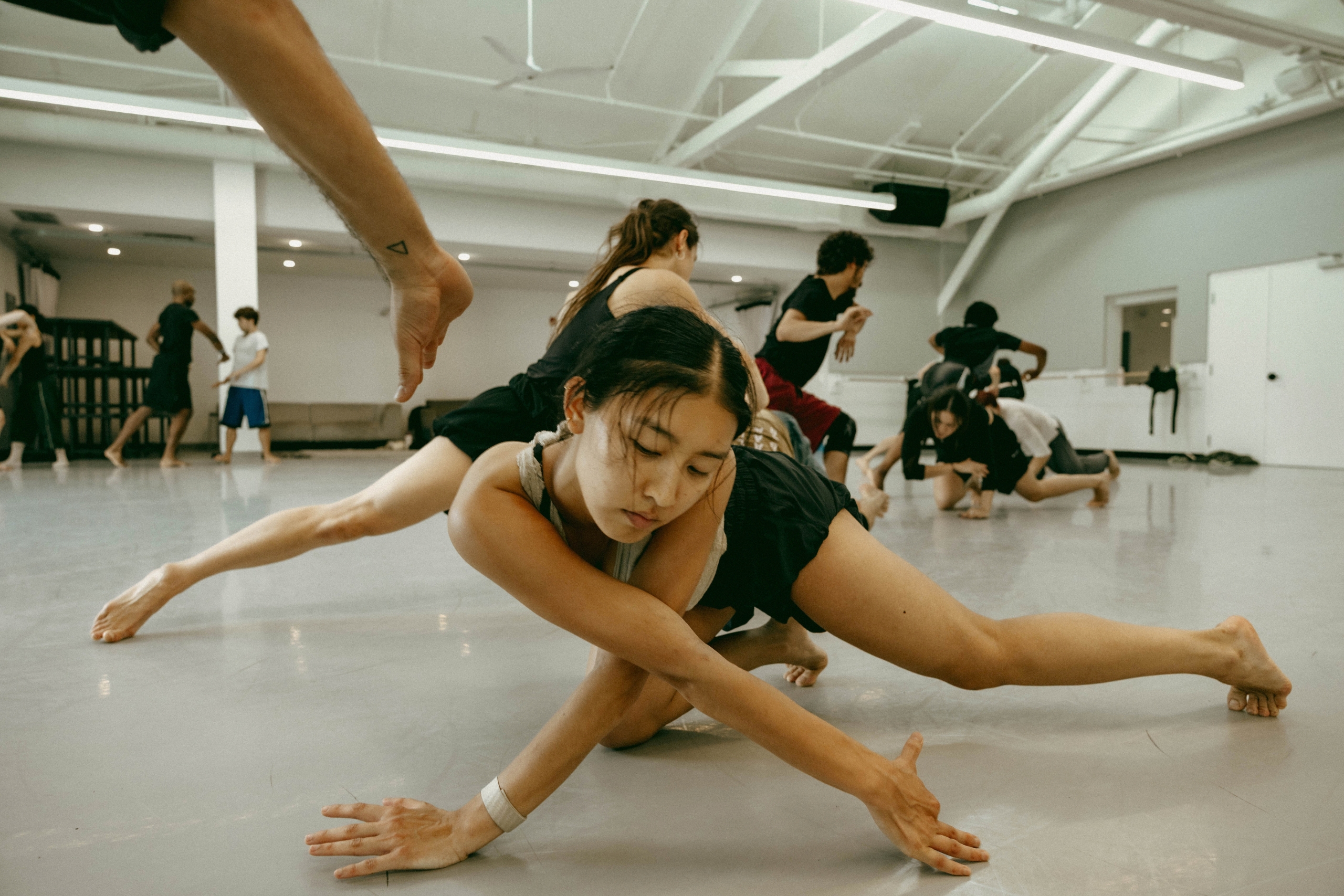 Ballet BC artist Kiana Jung. Photo by Millissa Martin.
Could you share a little bit about the music for Miriam?
M: We are collaborating with Amos Ben-Tal on a new composition for the work. He’s a long-time collaborator, and it’s been really beautiful to step into this world together. We were very inspired by the warmer sounds that he creates – the use of guitar, cello, there are lots of drums in there. We wanted it to be almost unplaceable, and kind of timeless or ancient, music that maybe has been around for a very, very long time. That’s something that we’ve been working very hard on.
Bodies & Voices is a double bill, featuring the North American premiere of I’m afraid to forget your smile alongside the world premiere of Miriam. What would you say about their connection?
M: We are very happy that I’m afraid to forget your smile is coming to Vancouver. It’s a piece that we created in 2022, and it is essentially about death, but also the fading memory of someone that you’re trying to hold on to. It is sort of about surrender to loss, and its circular nature as a transformative moment.
So that also brings us to Miriam in a way. I’m afraid is about death, and Miriam is about life, and we think there is a very beautiful thematic connection between the two works, even though they stand on their own. Does life bring us to death, or does death bring us to life? It’s an interesting thing to think about. It’s a full circle.
Discover the world of Imre and Marne at Bodies & Voices, November 5/6/7 at the Queen Elizabeth Theatre.
Buy tickets


