Ballet BC Annex to premiere a new work by Cameron sinkʷə Fraser-Monroe, whose choreographic voice weaves together classical ballet, contemporary, and traditional Coast Salish styles of dance. We sat down with Fraser-Monroe to discuss the inspiration behind the work, his experience in the studio with Annex dancers, and the importance of exposing young people to the arts.
Can you share a little bit about the genesis for the new creation, and the inspiration behind it?
As a man, I wanted to make a work about love between women. And I thought really hard about this, about whether I had something to say. But I was raised by two women, by my moms, and a whole constellation and extended family of aunties, and the work is ultimately a love letter to them. I think the other thing that was really interesting about this work was Woven Song by Ólafur Arnalds. It features the Shipibo matriarch Herlinda Agustin Fernandez, and she’s singing a beautiful Icaro with this undercurrent of atmospheric piano. For me and my artwork, whether I’m writing or dancing or choreographing, that’s something that I’m interested in: How can classical forms or contemporary expressions be in conversation with Indigenous forms? And for me, that song was such a beautiful reflection of that relationship, and ultimately the piece follows that same theme.
How did the process in the studio with the dancers unfold?
As a Tla’amin First Nation member, I grew up practicing a lot of traditional First Nations dances – grass dance, hoop dance, Coast Salish styles – before moving away from home and completing my classical training. And so, the start of every process for me as a choreographer begins with a lot of time rooting the movement through my own body to access that language and those vocabularies. Then as the dancers come to understand the movements, and we start to share some of those oral histories, I let go more and more, and I pass those movement pathways through their intelligence – whether that’s an understanding through the mind, but more importantly, an understanding through their bodies. Because ultimately, I’m most interested in the collective; I’m most interested in what we can do together with these shared languages, while respecting the integrity of our own lived experiences. That’s really the process in an arc.
When we get into the physicality of it, it means going slow. I have to be very organized to make sure that I have time when I’m incorporating elements of grass dance to share it the way it was shared with me – which is to go slowly, to demonstrate, to speak it. To leave space for questions, so that these dancers can approach a style that maybe they’ve never encountered before, and to be able to perform it in a way that is true to that traditional root movement. So that’s how we approach it when we’re in the studio as well.
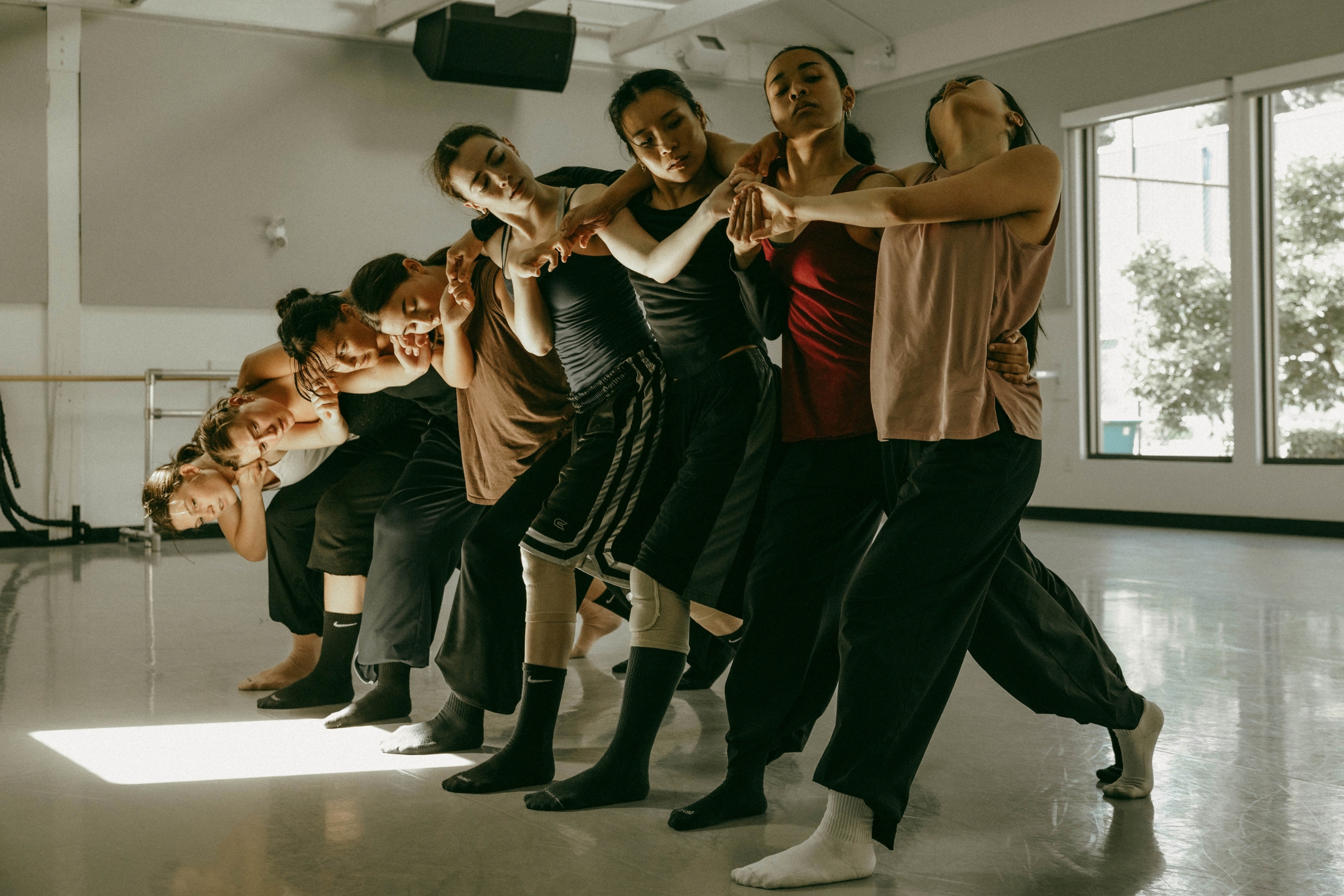 Artists of Ballet BC Annex. Photo by Millissa Martin.
How has your experience been working with this group of Annex dancers?
The Ballet BC Annex dancers have been incredible to work with. They’re so open, curious, supportive, and fun. Fun has been really a nice theme throughout. We have a lot of laughter, even while talking about serious things. There are eight women in the cast, and so I was interested in what that kind of partnering could look like. We spent a lot of time exploring center of weight, the way we pour into each other and and accept. But the most satisfying piece artistically was actually the vulnerability that they could build between themselves. For that, I leaned into some of the directing and acting training that I’ve done at the National Theatre School, in order to have them really see each other, really look into each other’s eyes, and then be able to hold space for each other in a completely different way – even when they’re not looking at each other. For me, that vulnerability, that care, was the most exciting part.
Can you tell us a bit more about the artistic collaborators involved in the creation?
Herlinda Agustin Fernandez’s song Icaro for Thunder and Lightning is just a little bit of atmosphere from her territory, and mostly her voice acapella. It’s quite striking, it’s quite beautiful, and I took that idea of having a conversation with whoever it is that controls thunder, and maybe having a bit of an argument about what is falling on the earth or not. The score is quite dynamic. It moves from atmospheric piano through shrieking chants, pounding drums, but the throughline that binds it all together is women’s voices as we move between three different composers.
That also became part of the lighting design with Jillian, who was able to turn the lighting into a character and a conversation as well, not just amongst the eight of them, but also with the space. So that was really exciting.
The costume design was done in collaboration with Ballet BC’s Kate Burrows. It was bringing together beautiful dresses made in house here at Ballet BC, with traditional woven motifs from the Tla’amin Nation. Being able to weave together—similar to the songs—those two aspects of the European and the traditional Tla’amin, was again a great statement about the ways that these pieces can function, these collaborations.
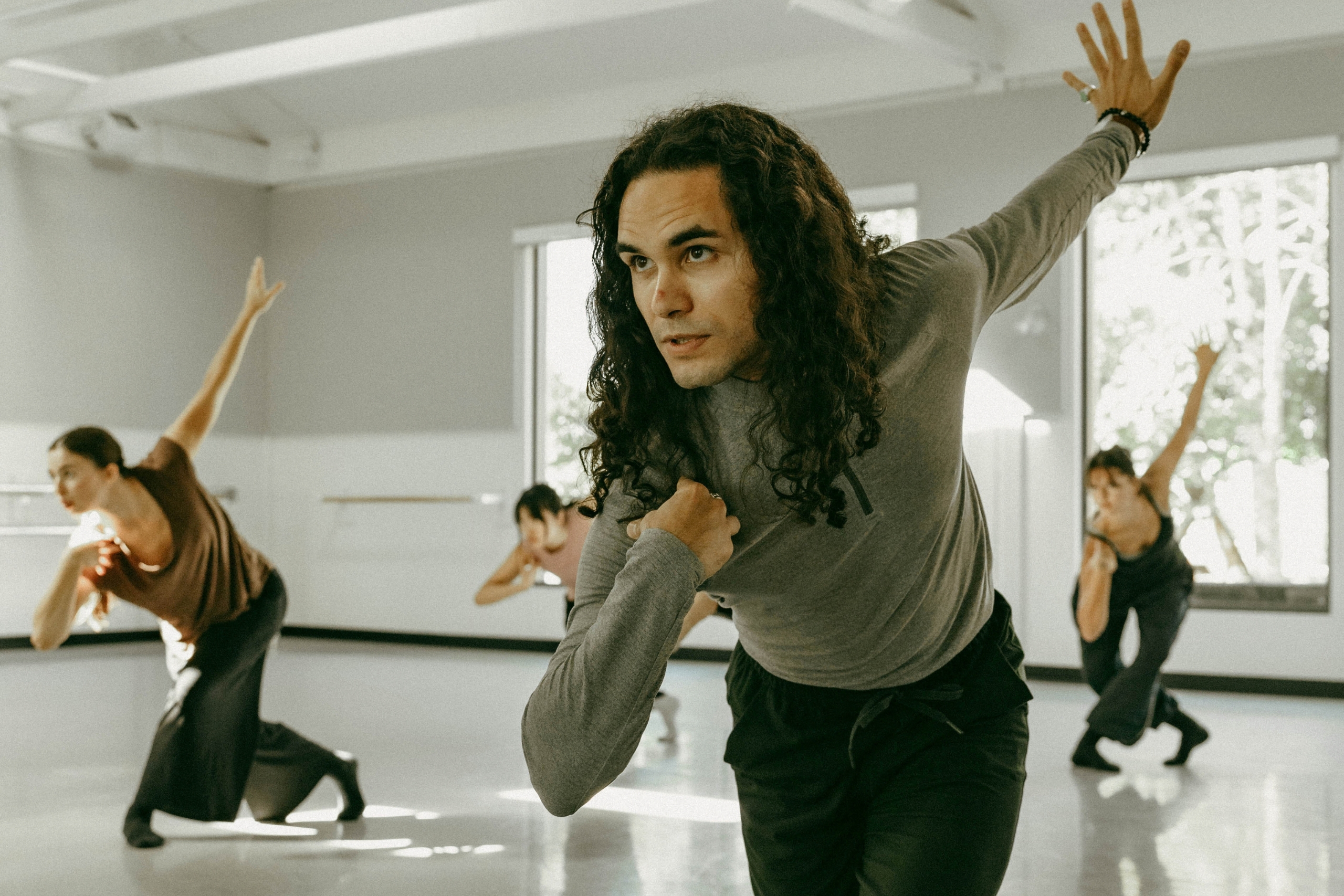 Ballet BC Annex Choreographer Cameron Fraser-Monroe. Photo by Millissa Martin.
Annex will tour the province, providing an opportunity for more than 4000 students to experience professional contemporary dance. How do you think about the importance of arts education?
I think arts education is everything. I grew up in Vernon, BC, a town of 30,000 people, and the reason that I’m an artist is because we had the Vernon and District Performing Arts Centre bringing in incredible companies way above the size of the community. So for me, bringing these stories back to those communities has really been central to my work. Two of my works have gone back to the Tla’amin Nation, to my 1200-member community, in order to make sure that these aren’t just seen in concert halls, but that they’re seen in all spaces. And I’d say that’s even the thesis of my work: Pieces that can show at New York City Center, and then the next weekend, go back to the Tla’amin Nation. So, for me, I’m so excited that the piece is going to tour all around my home province.
What should audiences keep in mind while watching this piece?
I believe that classical art forms should be in conversation with Indigenous cultures, and this piece is an invitation to start that conversation if you’re not already having it.
Beginning October 2026, Ballet BC Annex will tour with Cameron’s premiere across BC at Arts Umbrella, Alliance Française Vancouver, Burnaby’s Shadbolt Centre for the Arts, Arts Whistler, New Westminster’s Anvil Theatre, and more.
Info + tickets


